
RESEARCH
|
ENG
Many chemical and physical phenomena occur in transient states that persist only within ultrafast time windows of nanoseconds to femtoseconds, making direct observation exceptionally challenging. From microscopic events at the molecular or electronic level (energy transfer and charge transfer) to the resulting macroscopic changes in structure and electronic properties, all material transformations proceed through ultrafast dynamical processes. In essence, how these states are generated and evolve through such dynamics is the key determinant of a material’s function and performance.
Our laboratory investigates the ultrafast dynamics inherent in functional molecular and nanomaterials. We quantitatively track how excited states are generated, evolve, and decay over time. Furthermore, by directly observing how these dynamics lead to localized structural reconfigurations and shifts in electronic properties, we aim to elucidate the mechanisms governing structure-function correlations.
To analyze such ultrafast dynamics, we employ a pump–probe approach, in which a reaction is initiated by an external stimulus and the subsequent changes are tracked as a function of time. A femtosecond laser pulse (pump) is used to trigger the material response, followed by probing the state of the system after a defined delay, enabling direct tracking of the temporal evolution of the reaction. Based on this approach, ultrafast spectroscopy and ultrafast (transmission electron) microscopy serve as key tools for investigating ultrafast dynamics that emerge on fs to ns timescales. Ultrafast spectroscopy allows for time-resolved tracking of energy and charge dynamics in excited states, whereas ultrafast microscopy enables direct, spatially resolved observation of how these dynamics are linked to local structural and property changes.


Chemical Dynamics

To understand molecular behavior in biological reactions and chemical processes, it is essential to conduct reaction dynamics research that quantitatively identifies how processes progress over time. Reactions in the solution phase manifest as complex systems where intermolecular interactions, diffusion, and solvent reorganization occur simultaneously. These processes can only be fully decoded by tracking time-dependent changes at the molecular level.
To investigate these solution-phase dynamics, we utilize photoacid molecules as a model system. By employing fluorescence upconversion and time-correlated single photon counting (TCSPC), we track the generation and relaxation of excited states, proton transfer, and intermolecular diffusion across the femtosecond to nanosecond regimes. Through this, we aim to elucidate the fundamental principles governing reaction kinetics in solution environments.
Recommand Publications
- J. Phys. Chem. A 2025, 129, 447–458.
- Cell Rep. Phys. Sci. 2024, 5, 102155.
- J. Mol. Liq. 2021, 326, 115270.
Energy & Environment

Energy conversion materials, such as solar cells and photocatalysts, are actively studied as key components for efficiently utilizing solar energy and enabling sustainable energy technologies. The performance of these materials is largely governed by energy transfer and charge dynamics that occur immediately after photoexcitation. Losses and inefficiencies arising during these early processes often limit their practical applications.
To understand these limitations, ultrafast spectroscopic techniques are employed to track the generation and relaxation of excited states on fs to ns timescales. By applying transient absorption spectroscopy and fluorescence upconversion spectroscopy in a complementary manner, we selectively probe excited-state formation and decay, charge transport processes, and the relaxation dynamics of emissive states. Through these measurements, we elucidate the fundamental mechanisms that govern loss pathways and limit efficiency in energy conversion processes.
Recommand Publications
- Energy Environ. Sci. 2025, 18, 8161–8170.
- Chem. Eur. J. 2024, 30, e202402370.
- Small 2023, 19, 2206547.
Quantum Nanophotonics

Light–matter interactions at the nanoscale are governed by localized electronic excitations and collective modes, giving rise to optical responses that are fundamentally different from those of bulk materials. These responses are highly sensitive to the geometry, size, composition, and surrounding environment of nanostructures, providing critical insights into the origins of localized optical functionalities. In particular, excitation and emission processes are often confined to specific regions within a nanostructure, and such spatially localized behavior cannot be adequately captured by conventional ensemble-averaged optical measurements.
To probe excited states and energy flow within nanostructures, we employ ultrafast electron microscopy–based cathodoluminescence (CL) and electron energy-loss spectroscopy (EELS). CL enables direct visualization of electron-beam-induced radiative processes, while EELS provides complementary information on localized electronic excitations and non-radiative energy dissipation pathways. Time-resolved CL measurements are performed using both a femtosecond streak camera and nanosecond time-correlated single-photon counting (TCSPC), allowing us to access ultrafast carrier dynamics as well as long-lived emission processes across a broad temporal range. Through this multimodal approach, we aim to correlate local structure, electronic excitation, and emission dynamics with nanoscale optical functionality at high temporal and spatial resolution.
Recommand Publications
- ACS Nano 2024, 18, 33441–33451.
- ACS Nano 2024, 18, 4911–4921.
- ACS Nano 2021, 15, 19480–19489.
Ultrafast Structural Dynamics
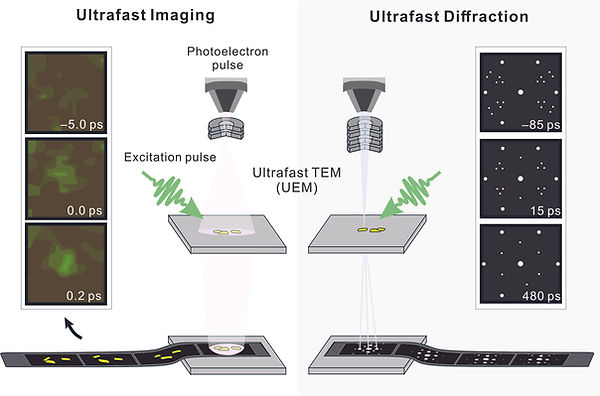
The properties of matter are not fully explained by static structures alone. Instead, transient dynamics and functions emerge from structural transformations induced by external stimuli. To elucidate the structural changes following strong photoexcitation, it is essential to understand the complex dynamics intertwined with electron distribution, lattice structure, and collective excitation modes, which serve as key determinants of a material's functional response.
To investigate these ultrafast structural dynamics, we employ time-resolved imaging and diffraction techniques using ultrafast microscopy. By directly tracking structural transformations and electronic responses with femtosecond time resolution, we aim to uncover how excited-state dynamics translate into atomic and crystalline rearrangement. Our goal is to understand the structural origins of emergent physical properties and track their temporal evolution.
Recommand Publications
- Nano Lett. 2023, 23, 3645–3652.
- Sci. Adv. 2023, 9, eadd5375.
- ACS Nano 2020, 14, 11383–11393.
Facilities

Ultrafast Electron Microscopy (UEM)
nm, fs resolution

Streak Camera
fs resolution

Transient Absorption (TA)
fs resolution

Time-Correlated Single Photon Counting (TCSPC)
ps resolution

Fluorescence Upconversion
fs resolution